What students learn
- How the National Grid carries electricity
- Electrical power: P = I × V
- Power wasted in cables: P = I² × R
- Why high voltages waste less energy
- Step-up and step-down transformers
- Current ratings of cables
- Underground and undersea cables
- Planning a network on a budget
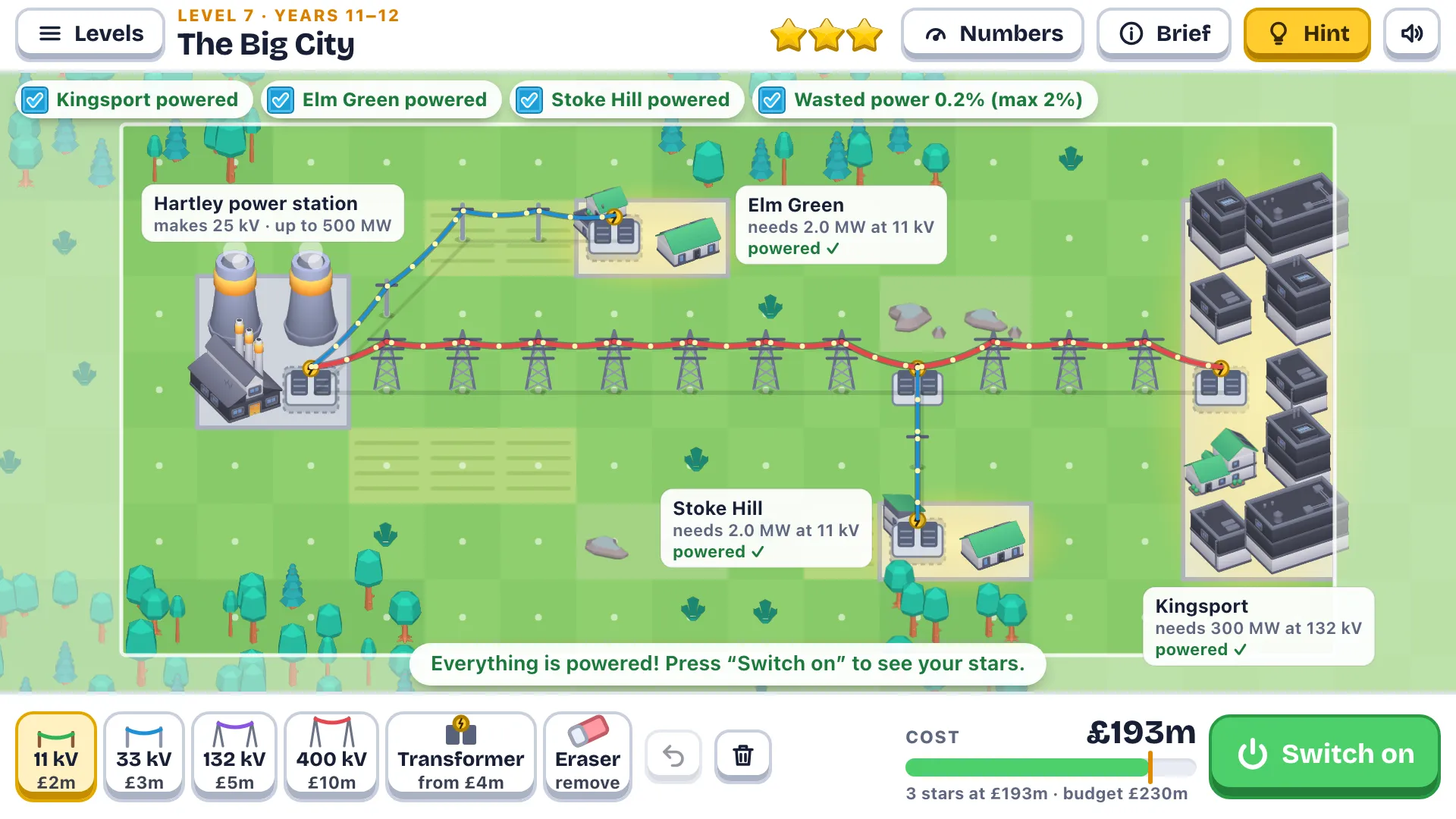
Power Lines is a free National Grid game. Students build the network that carries electricity from power stations to towns, a steelworks, a city and an island: overhead lines on poles and pylons, transformers to change the voltage, and underground or undersea cables where pylons aren’t allowed. Every network is solved like a real one. The current in each line comes from the power it carries (P = I × V), the energy wasted heating it is P = I² × R, and every line has a current it can’t safely go above. Send too much power at too low a voltage and the line glows red-hot, or so much voltage is lost on the way that the power never arrives.
How to play
Each level is a map. Choose a line from the toolbar at the bottom, then drag from the power station’s yard (the grey square with the yellow ring) to the place that needs power. Lines join the middles of the squares, across, up, down or diagonally. Where two voltages meet you need a transformer: choose the transformer tool and tap the square. Places come to life when they’re powered, and moving dots show the power flowing. Then press Switch on. Turn on Numbers to see the current in every line, the power it wastes and the voltage each place receives.
Each level earns up to three stars: one for a network that works, two for staying within the budget, and three for matching the cheapest design we know.
The levels
| # | Level | Years | Big idea |
|---|---|---|---|
| 1 | Switch On | 9 | Power lines carry energy: P = IV |
| 2 | Far Away Farm | 9 | Long lines waste energy: P = I²R |
| 3 | Step Up, Step Down | 10 | Transformers and transmission voltages |
| 4 | The Steelworks | 10 | Current ratings and 400 kV lines |
| 5 | Two Towns | 10–11 | Networks: currents add at a junction |
| 6 | The National Park | 11 | Underground cables cost more |
| 7 | The Big City | 11–12 | The grid’s hierarchy of voltages |
| 8 | Wind at Sea | 12–13 | Offshore wind and undersea cables |
Tips for teachers
- Year 9: before anyone builds Far Away Farm, ask the class to work out the current an 11 kV line needs to carry 2 MW (I = P ÷ V), then let them try it and see what happens.
- Years 10–11: Step Up, Step Down and The Steelworks show why the National Grid uses transformers and very high voltages. Ask students to compare the current and the wasted power at 33 kV and 132 kV with the Numbers button.
- Years 12–13: Two Towns and The Big City are real design problems: where to split a line, and when a separate small line is cheaper than tapping the big one. Wind at Sea adds the cost of undersea cable.
Every level ends with a short “What you learned” summary you can use as a plenary.
Curriculum links
- GCSE Physicsthe National Grid, transformers and why power is transmitted at high voltage
- GCSE PhysicsP = IV and P = I²R
- A-level Physicspower losses in transmission lines and resistance of wires
- Engineering and post-16power system design, network costs and offshore wind
Controls
| Drag from square to square | Build a line (across, up or diagonally) |
|---|---|
| Tap a square | Place a transformer (with the transformer tool) |
| Tap a line | Remove it (or use the eraser) |
| Arrow keys + Shift | Build with the keyboard (Home, End, Page Up and Page Down go diagonally) |
| Number keys / E | Choose a tool / the eraser |
| Ctrl + Z | Undo |
Questions about Power Lines
Is Power Lines free?
Yes. Power Lines is free to play in any web browser, with no ads, no sign-up and nothing to install. The teacher pack is free too.
What age is Power Lines for?
Power Lines is for ages 13–18. Its 8 levels are labelled by school year and cover Years 9–13 in the UK (Grades 8–12 in the US). The first levels need no previous knowledge and the last ones reach A-level ideas.
What do students learn in Power Lines?
The levels cover:
- How the National Grid carries electricity
- Electrical power: P = I × V
- Power wasted in cables: P = I² × R
- Why high voltages waste less energy
- Step-up and step-down transformers
- Current ratings of cables
- Underground and undersea cables
- Planning a network on a budget
Is there a teacher pack for Power Lines?
Yes. A free 15-page PDF you can download from this page. It includes:
- Two 60-minute lesson plans (Years 9–10 and 11–13)
- Two worksheets, with answers and a mark scheme
- A level-by-level guide with the 3-star designs
- Curriculum links (KS3, GCSE, A-level, NGSS)
Does Power Lines work on Chromebooks and iPads?
Yes. It runs in any up-to-date browser on Chromebooks, Windows and Mac computers, iPads, Android tablets and phones, with a mouse, touch or keyboard. A bigger screen makes the later levels easier.