What students learn
- A circuit must be a complete loop
- Series and parallel circuits
- Switches in branches
- Voltage is shared in series
- Ohm's law: V = IR
- Electrical power, P = IV, and fuses
- Potential dividers and loading
- Cable resistance and power losses
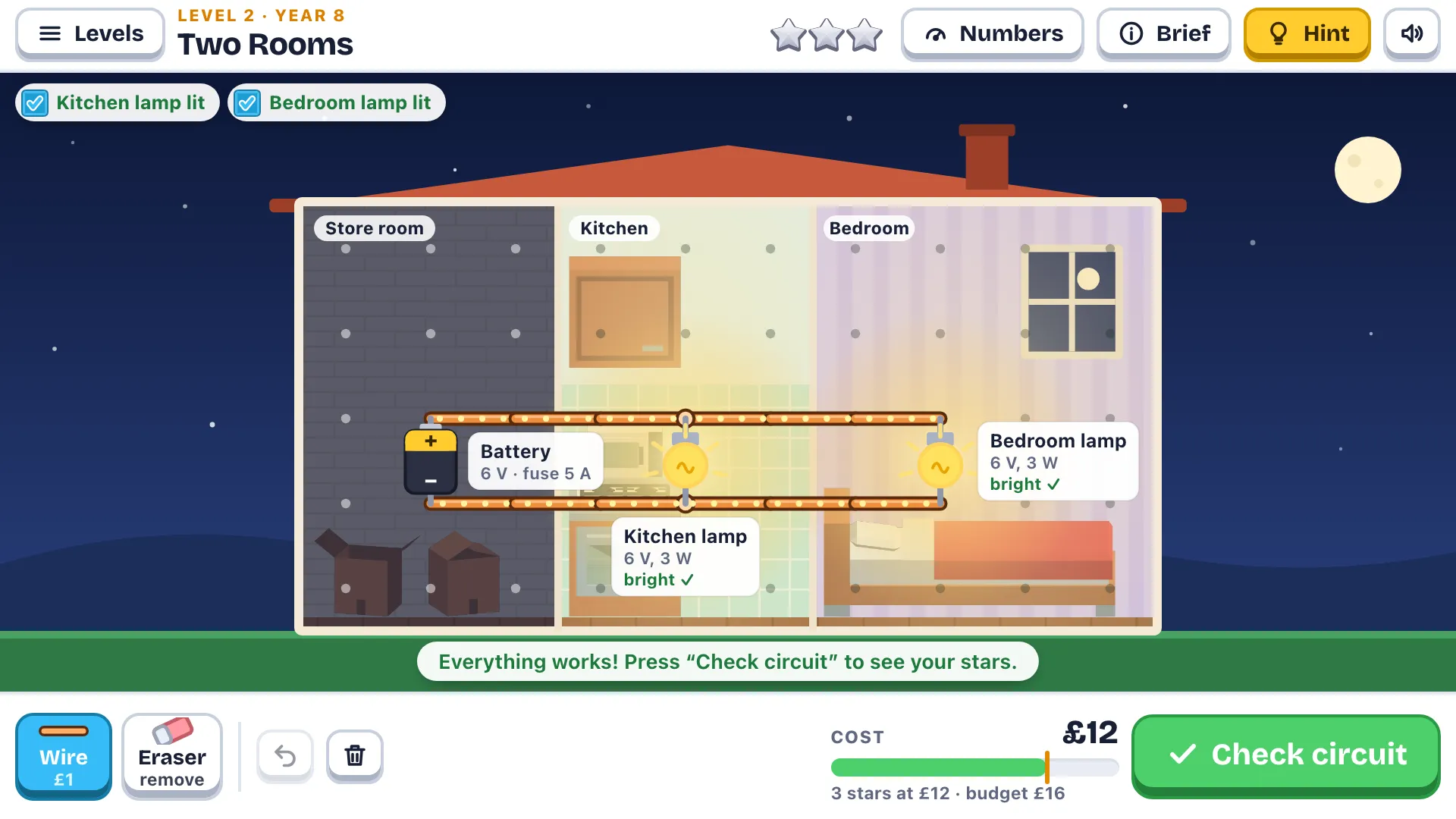
Light It Up is a free circuit-building game. Students wire up the rooms of a house so the lamps, doorbell and heater all work, and try to do it within a budget. Behind the scenes the game solves every circuit the way an electrical engineer would, so the voltages and currents are real. Put two lamps in series and they really do glow dimmer. Draw too much current and the fuse really does blow.
How to play
The house is dark until you wire it up. Choose a part from the toolbar at the bottom, then drag along the dots on the walls to lay it: wire at first, then resistors and thick cable on later levels. Connect every lamp and appliance to the battery, and each room lights up as its lamps start working. Then press Check circuit. Turn on Numbers to see the voltage and current at every part, along with its circuit symbol, and watch the current flow around the wires.
Each level earns up to three stars: one for a circuit that works, two for staying within the budget, and three for matching the cheapest design we know.
The levels
| # | Level | Years | Big idea |
|---|---|---|---|
| 1 | Lights On | 8 | A complete loop |
| 2 | Two Rooms | 8 | Series vs parallel brightness |
| 3 | The Hall Switch | 8–9 | Switches in branches |
| 4 | Twelve Volts | 9 | Voltage shared in series |
| 5 | Pick the Resistor | 10 | Ohm’s law, resistors in series |
| 6 | Two Fuses | 10–11 | I = P ÷ V, currents add in parallel |
| 7 | Smart Doorbell | 11–13 | Potential dividers and loading |
| 8 | Power to the Shed | 12–13 | Cable resistance and losses |
Tips for teachers
- Years 8–9: before anyone presses Check, ask the class to predict which lamp will be brighter, and why. Levels 1–4 make series and parallel easy to see.
- Years 10–11: in levels 5 and 6, ask students to work out the resistor or the fuse current on paper first, then build it and check with the Numbers button.
- Years 12–13: Smart Doorbell shows why a potential divider’s output drops when you connect a load, and Power to the Shed shows why long cables waste power.
Every level ends with a short “What you learned” summary you can use as a plenary.
Curriculum links
- KS3 Scienceelectric circuits, current, potential difference and resistance
- GCSE Physicsseries and parallel circuits, V = IR, P = IV, fuses
- A-level Physicspotential dividers, resistance of wires and power losses
Controls
| Drag along the grid | Lay wire or another part |
|---|---|
| Tap a piece | Remove it (or use the eraser) |
| Arrow keys + Shift | Lay the chosen part with the keyboard |
| Number keys / E | Choose a part / the eraser |
| Ctrl + Z | Undo |
Questions about Light It Up
Is Light It Up free?
Yes. Light It Up is free to play in any web browser, with no ads, no sign-up and nothing to install. The teacher pack is free too.
What age is Light It Up for?
Light It Up is for ages 12–18. Its 8 levels are labelled by school year and cover Years 8–13 in the UK (Grades 7–12 in the US). The first levels need no previous knowledge and the last ones reach A-level ideas.
What do students learn in Light It Up?
The levels cover:
- A circuit must be a complete loop
- Series and parallel circuits
- Switches in branches
- Voltage is shared in series
- Ohm's law: V = IR
- Electrical power, P = IV, and fuses
- Potential dividers and loading
- Cable resistance and power losses
Is there a teacher pack for Light It Up?
Yes. A free 16-page PDF you can download from this page. It includes:
- Two 60-minute lesson plans (Years 8–9 and 10–13)
- Two worksheets, with answers and a mark scheme
- A level-by-level guide with the 3-star designs
- Curriculum links (KS3, GCSE, A-level, NGSS)
Does Light It Up work on Chromebooks and iPads?
Yes. It runs in any up-to-date browser on Chromebooks, Windows and Mac computers, iPads, Android tablets and phones, with a mouse, touch or keyboard. A bigger screen makes the later levels easier.